In a cluster-paying slot, a win comes from a connected group of matching symbols. A cascade, also called a tumble or cascading reels, is what happens afterwards: winning symbols leave, the remaining symbols fall and new ones fill the gaps. The next board can produce another win within the same paid spin.
Those are two different rules to check. One tells you which symbols pay; the other tells you what happens after a win. Here we follow both through examples from Stompkin HD, Neon Eclipse and Velvet Splice.
What counts as a connected cluster?
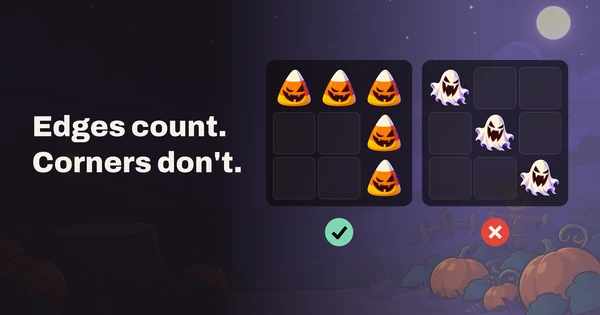
All three games require at least five matching paying symbols connected up, down, left or right. The group can turn a corner or branch. It does not need to make a straight line, begin at the left edge or span every column.
Imagine three matching symbols across a row, with two more directly below the rightmost one. You can walk from any symbol to any other along shared edges, so all five form one group. Move the last two away so that they touch the others only at corners, and they are no longer part of that group.

Five matching symbols somewhere on the board are not automatically a win. If they split into a group of three and a separate pair, neither reaches five. If two qualifying groups are separated, they are assessed as separate groups rather than combined into one larger paytable tier.
The minimum size and connection rule belong to each game's rules. These examples do not establish a universal five-symbol threshold for every slot described as cluster pays.
What determines the cluster's ordinary payout?
The paytable looks at the symbol and the size of its connected group. That gives an amount before any applicable multiplier. A larger group can move into a different paytable tier; it is not simply the five-symbol payout multiplied by the number of symbols.
For example, Stompkin HD pays 0.20× the base bet for five candy corn symbols and 0.30× for five wrapped toffees, before its flame multiplier. These are different symbol values despite the same group size.
Special symbols have their own roles. Stompkin's Wisps trigger its feature rather than pay as ordinary clusters. Velvet Splice's Golden Shuttle changes cells, while its Moth Medallions trigger free spins; neither joins a paying group. Count ordinary paying symbols according to the paytable, then apply the game's separate feature rules.
A cascade, step by step
When a board contains qualifying groups, these games assess its winning groups together. The winning symbols then disappear. Surviving symbols fall down their columns, new symbols enter from above, and the resulting board is checked again.
- Identify each connected paying group.
- Read its paytable value and apply the multiplier rule that is active for that step.
- Remove the winning symbols.
- Drop surviving symbols and fill the spaces.
- Check the new board. Continue while another group pays, subject to the game's round cap.
A falling symbol can join a new group even if it did not win on the previous board. Conversely, a visually busy drop can produce no qualifying group. In that case the paying cascade sequence ends; a separately triggered feature is handled under its own rules.
These extra cascade steps are part of the paid spin. They are not additional paid spins, and they are not the same thing as a free-spins feature awarded by scatters.
Calculate two Stompkin HD steps
Take an illustrative base spin with a base bet of 1 unit. On its first board, a five-candy-corn group and a separate five-toffee group both pay. Their ordinary values add to 0.20 + 0.30 = 0.50 units.
Jack's flame begins at ×1. The step therefore pays 0.50 × 1 = 0.50 units, then the flame advances to ×2. Both groups count as one paying step, so they advance the flame once, not twice.
After the symbols fall, suppose the next board contains five swirl lollipops. Their paytable amount is 0.40× the base bet. The current ×2 flame makes this step 0.40 × 2 = 0.80 units. The flame advances again, to ×3.
If no later group pays and no free-spins feature starts, the round returns 0.50 + 0.80 = 1.30 units. The next ordinary base spin begins with the flame back at ×1. These selected boards demonstrate the calculation; they are not a recorded round or an estimate of how often it occurs.
How a colour change reshapes a cluster in Needle Drop
In the recorded base spin below, Needle Drop changes two records before it checks for a win. Look at the fourth row of the first frame. Two blue Cobalt Records sit in the first and fourth columns, with a crowned Gold Record between them in column two. The needle turns both blue records crimson.

The Gold Record acts as a wild. That makes a seven-symbol Crimson group worth 1.65× the bet. Those seven symbols clear. As the board refills, seven Microphones connect for 2.64×. Both groups use the base game's ×1 multiplier, so the spin returns 1.65 + 2.64 = 4.29× the bet.
In the Stompkin example the second step paid more because Jack's flame had risen. Here both groups have seven symbols and the multiplier stays the same. The Microphone simply pays more than the Crimson Record at that group size. Our Needle Drop guide shows how long a flipped colour stays off the board.
Why the same cascade can pay differently in another game
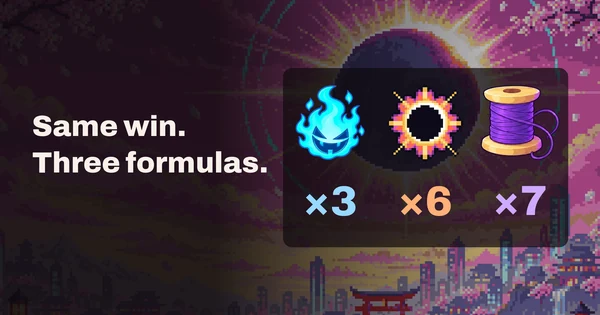
The remove-and-refill sequence does not tell you how multipliers work. Stompkin HD uses one flame value for a paying step. Neon Eclipse reads the Moon Wards underneath each individual cluster. Velvet Splice reads the thread charges on that cluster's cells and adds one to their sum.
That changes what you need to watch. In Stompkin, check the current flame. In Neon Eclipse and Velvet Splice, check where the paying group lies. A developed cell elsewhere on the board does not contribute to a group that never covers it.
Our Moon Wards explanation follows a cell through successive clears. The Velvet Splice game page explains how the shuttle creates its threads and charges.
Does a bigger grid mean better returns?
Grid dimensions tell you how much space the game uses, not its return. Stompkin HD has six columns and five rows, Neon Eclipse has six by six, and Velvet Splice has five by five. Their rules also differ in symbols, payouts, features and how complete rounds are distributed.
RTP is calculated across that whole distribution. A large board, a long cascade or a high multiplier on screen does not establish an advantage on the next spin. Our guide to RTP and volatility explains why a long-run return cannot predict a short session.
What to check in a game's rules
Before interpreting a board, check the minimum cluster size, the allowed connections, the paying symbols and their size tiers. Then check when multipliers are read, what survives a cascade and what resets before the next spin.
Finally, check the round limit. Stompkin HD and Velvet Splice cap a round at 15,000× the base bet; Neon Eclipse caps it at 10,000×. Those limits are ceilings, not typical results. Always use the current in-game rules for the version you are playing.