Free spins are rounds that cost nothing once a feature has started: the spin that started it paid for all of them. In our games a feature starts when enough scatters land. A scatter counts anywhere on the board, touching the others or not; Clockwork Peacock's Bracket Clock, for one, pays nothing itself and only counts. What happens next depends on how many landed, what the feature keeps, and whether more scatters can add spins.
Three, four or five
In our newer games the count decides which feature starts:
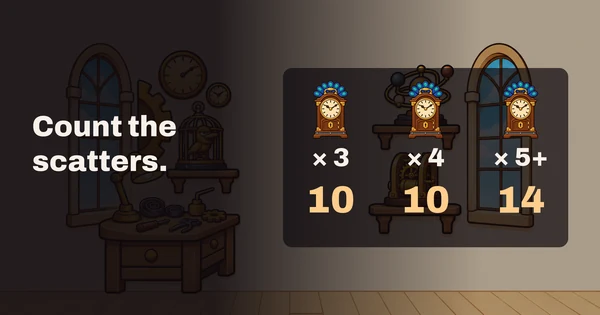
- Clockwork Peacock: 3 Bracket Clocks start Peacock Hour (10 free spins), 4 start Midnight (10), 5 or more start Grand Complication (14).
- Needle Drop: 3 turntables start Side B (10), 4 start Gold Pressing (12), 5 or more start Master Pressing (20).
- Stonewake: 3 moons start Moonrise Spins (10), 4 start Full Moon Spins (10), 5 or more start Witching Hour (12).
- Shelf Life: 3 Sardine Tins start Zoomies (10), 4 start 3 A.M. (12), 5 or more start Nine Lives (15).
The higher tiers do not only last longer: they start further along. Needle Drop's Master Pressing starts with one colour left and the platter at its top speed, ×5. Clockwork Peacock's Grand Complication starts with a gear on every cell, each worth 1. Shelf Life's Mess starts at ×1 in Zoomies, ×10 in 3 A.M. and ×20 in Nine Lives.
What a feature keeps
This is where free spins differ from base spins. In the base game these reset after every spin; in the free spins they stay until the feature ends:
- Shelf Life's Mess, the multiplier on every win of the spin, stays from spin to spin and only grows, up to ×100.
- In Stonewake every gargoyle kind keeps the rank it has climbed.
- Clockwork Peacock's gears stay on their plate, and the Crank winds up to 2 of them one step on every free spin.
- In Needle Drop a colour the needle turned over stays gone for the rest of the feature.
- Glasswright's panes, Neon Eclipse's Moon Wards and Velvet Splice's thread charges stay on their cells.
A kept multiplier makes the end of a feature worth more than its start, because the last spins play with everything the first ones built. That is also why the tiers that start further along cost more to buy: bonus buys and boosted bets compares the prices.
Retriggers
3 or more scatters during the free spins add more of them: 5 free spins in Clockwork Peacock, Needle Drop, Stonewake, Glasswright and Neon Eclipse, and 4 in Shelf Life and Velvet Splice.
When the scatters are counted differs between games. Neon Eclipse and Amethyst Crown count the board as it lands. Glasswright, Domino Slam, Stompkin HD and Rust Rook count it at the end of the free spin's tumble sequence, so a scatter that drops in during a tumble can still complete a retrigger.
When a feature ends early
A feature ends when its spins run out, or earlier at the max win: reaching it ends the round at once, and the spins left are forfeited. In Clockwork Peacock that includes the strike that would close its free spins. What a max win cap means explains the ceiling.
How often
Features are rare by design. In Needle Drop's base game one starts about 1 spin in 358. Its Ante, at 3× the bet, makes turntables land more often, so a feature starts about 1 spin in 62.
What to read in the rules
- How many scatters start each tier, and what each tier starts with.
- What stays from spin to spin, and what resets.
- How many spins a retrigger adds, and when the scatters for it are counted.
- What happens to the spins left if the round reaches the max win.