Rust Rook's scrap magnets: adding a multiplier, keeping a hoard
How scrap magnets multiply a spin in Rust Rook, why Night Shift keeps their values, and how we balance a hoard that lasts for the whole feature.
4 min readGame design, Slot math, Rust Rook
Rust Rook is coming soon. Its weathered raven works a night salvage yard, pecking winning scrap apart and carrying magnets into a hoard bucket. We built the mechanic around that collecting habit: a magnet changes the result of a paying spin, and in Night Shift its value stays in the hoard until the feature ends.
Three questions shape it: when a magnet counts, how its value combines with the others, and how long that total lasts.
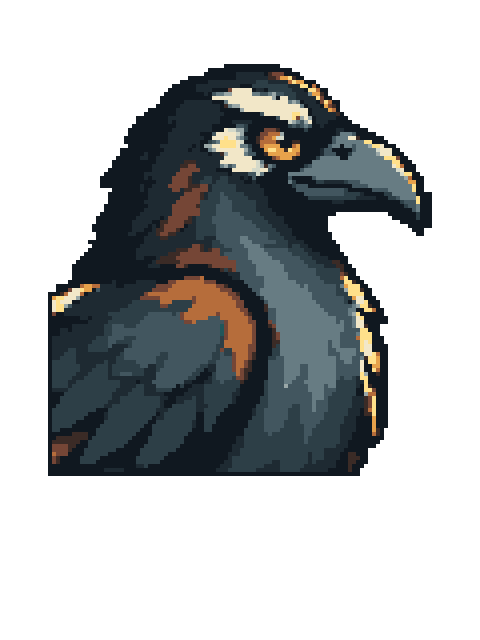
The raven and a scrap magnet from Rust Rook.
Add the magnets after the tumbles
We start with a board of six columns and five rows. Groups of five or more matching paying symbols connected up, down, left or right pay together. Those groups disappear, the remaining parts fall straight down, and new parts drop in. We repeat that process until there are no paying groups left.
Scrap magnets sit alongside the paying symbols. Each carries a value of ×2, ×3, ×5, ×10, ×25, ×50 or ×100. A magnet does not pay as a symbol and is never removed by a paying group. It falls with the other parts and keeps its value. New magnets can also arrive during a tumble.
We count the magnets on the final board, after the sequence has finished. For a paying base spin, we add their values and use that sum to multiply the whole spin's raw result. The saved round we use to check this behaviour ends with two ×2 magnets, giving a ×4 multiplier. The calculation happens once at the end, so a magnet that survives several tumbles is still counted once.
With no magnets, the multiplier is ×1. With no paying groups, the magnets do nothing. They need a raw result to multiply; their presence alone does not make a spin pay.
Keep the hoard for the shift
Four or more work lanterns on the final board of a base spin start Night Shift with ten free spins. Three or more lanterns at the end of a free spin add five more. We count lanterns after the tumbles, just as we count magnets.
Ordinary Night Shift starts with an empty hoard. At the end of each paying free spin, we add every final-board magnet's value to that hoard, then multiply the spin's raw result by the new hoard total. The additions affect the spin that collected them as well as later paying spins. While the hoard is empty, the multiplier remains ×1.
A free spin that pays nothing adds nothing, even if magnets are on its board. It also leaves the existing hoard intact. A later paying spin can use that stored multiplier without finding another magnet. The hoard never resets within the feature, but it is not carried into the next ordinary Night Shift.
The hoard stays for the feature; only paying free spins add magnets to it.
We keep the bucket and its multiplier visible throughout Night Shift. At the end of a paying sequence, magnets glow in turn and their values travel into the bucket. We then show the raw result, the multiplier and the total. That order follows the calculation: finish the groups, collect the magnets, apply the hoard.
Weight small magnets more heavily
Persistence changes the balancing problem. A base-game magnet affects its own spin. A Night Shift magnet also becomes part of the multiplier for the remaining paying spins. We therefore give the lower magnet values much more weight in free spins.
The rules store relative weights, not an equal chance for every value. In the base game, ×2 has weight 500, ×3 has 250 and ×100 has 5. In free spins, those weights are 700, 200 and 0.12. We retain the same set of values, but lean much harder towards small additions in the hoard. These are inputs to our generator; the finished round tables also have their own calibrated weights.
There is another constraint behind that choice. Direct entry to Night Shift costs 100× the base bet and starts the hoard at zero. Super Night Shift costs 400× and starts it at ×10. Both use the same rules for drawing free-spin boards. The starting hoard changes the multiplier calculation without changing how the generator draws a board.
We balance those starting points against the same long-run RTP. The initial hoard in Super is already available to its paying spins, whereas ordinary Night Shift builds its hoard from collected magnets. The math notes identify that relationship as the reason free-spin magnets favour small values. Increasing their values would change both modes, because both keep the additions until the shift ends.
Check the complete round
We check whole rounds, including every tumble and free spin. The Rust Rook dataset contains 641,158 recorded rounds. An independent checker replayed all of them with its own group finding, gravity, paytable and hoard calculations, reporting zero problems.
The display reads the recorded sequence rather than calculating the rules again. Each free spin records the hoard before and after collection, its raw result and its multiplier. That gives us a direct way to check that the bucket agrees with the maths. We also check the round cap: reaching it ends the round immediately, with no further tumbles or free spins.
We calibrated the round weights to an exact 96.50% RTP in every mode. Our post on how we test a slot's math explains that weighted average in more detail.
RTP describes the long-run average of the complete table. It does not predict a session or a next spin. A growing hoard is a rule inside one feature, not a promise about what that feature will return.
18+ only. Stake.com is not available in every country, including the US, UK and Australia. Gambling can be addictive, so play responsibly. Responsible gambling on Stake
A weathered raven pecks winning scrap apart in a night salvage yard. Scrap magnets from ×2 to ×100 multiply the spin, and in Night Shift free spins the raven hoards them for good.
What RTP, hit rate, volatility and max win mean, how we check them over 600,000+ simulated rounds per game, and why RTP says nothing about your next spin.