We released fifteen slots on Stake through Stake Engine between 1 October and 7 November 2026, as a small independent studio. This is the path each of them took, with the platform's own numbers and the things we wish we had known on the first one. Engine's documentation is the authority: stake-engine.com/docs.
The four steps
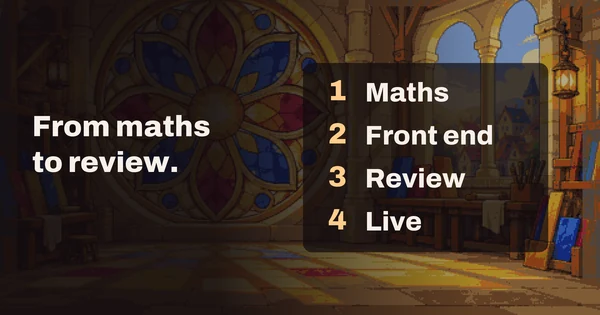
Engine describes the road in four parts: a team account, the game's maths, the front end, and the approval review. Two rules shape everything else:
- The game is stateless. Every bet stands alone. No jackpots, no gamble feature, no continuation between rounds, no early cashout.
- The build is static. The front end can use any web stack, but it ships as plain HTML, CSS, JavaScript and assets on Engine's CDN, and talks to Engine's game server for every round.
The maths comes first
An Engine game does not compute results while you play. Each mode ships a finished set of rounds, simulated in advance, and the server picks one by weight. For every mode a studio uploads three files:
index.json, which names the modes, their costs and their files;- a lookup table, a CSV of round number, weight and payout;
- the rounds themselves, a compressed JSON-lines file with the events the front end plays back.
On upload the server checks that the payouts in the table and in the rounds match exactly. Engine's Math SDK produces these files; we use it for every game.
Before review, the numbers have to meet Engine's math requirements:
- an RTP between 90% and 98%, with every mode within 0.5 percentage points of the others;
- a max win that matches the rules and can really happen;
- 100,000 to 1,000,000 simulated rounds for a slot, so a session does not see repeats;
- enough paying rounds, no gaps between small wins and the top, and a base game whose spread of results is within industry norms.
We set every mode's RTP to the same value and publish the RTP and max win per mode in each game's rules. How we check that before release is in how we test slot math.
The front end
The front end plays a round's events back: the board, the wins, the features, the totals. The reviewers check that it shows exactly what the maths decided, and that a player can find everything:
- the rules and a paytable with every symbol, and each mode's cost;
- the balance, the bet, the win, and controls that work on a phone as well as a desktop;
- replays, so any past round can be shown again exactly;
- the wording rules of each market the game is offered in.
Engine's Web SDK handles much of this; we built our own kit on top of the same pieces.
The review and the rating
Every submission is reviewed by three anonymous reviewers. Each gives a score from 0 to 3 stars in thirds, and the average, rounded, is the game's quality ranking. Below an average of 1 the game is not published, and the thread reopens after seven days. The ranking decides how visible a game is: the higher tiers get priority in New Releases and Stake's promoted categories.
Two consequences shaped how we work:
- Finish before you submit. After approval only minor visual fixes are allowed: the maths, the modes and the mechanics are fixed for good.
- The review judges the whole game. Art, motion, sound and clarity count as much as the maths. A game that is correct but looks rushed is rated as rushed.
After approval
An approved game goes live on Stake, usually within hours. Two more things are worth doing on day one:
- Decide where it plays. At the first submission a studio chooses between Only on Stake and the Engine Network, which offers the game to other casinos too. Engine Network for studios explains the trade.
- Fill in the game's profile and media on Engine: a banner, a tagline, a description, and logos, tiles and art that casinos can use.
What we would tell a new studio
- Build the maths first and simulate every mode before drawing anything that depends on it.
- Write the rules from the maths files, not from memory: every number a player reads has to be true in every mode.
- Treat the first review as the only one. Polish until the game would hold up next to the best on Stake.
- Test on a real phone, with slow network and reduced motion.
- Keep every build you submit, with its hashes: when something is questioned, you can show exactly what was reviewed.
Our games, their rules and their maths are on our games page; every one can also be tried as a free demo on Engine.