A wild stands in for other symbols. In a cluster game, where groups of 5 or more equal symbols touching up, down, left or right win, a wild joins a group next to it as if it were one of them. That much is common to every wild. Everything after it is the game's own rule, and the rules are where two wilds that look alike turn out to work very differently. Cluster pays and cascades covers how a group forms; this guide is about the symbols that help it.
The plain wild
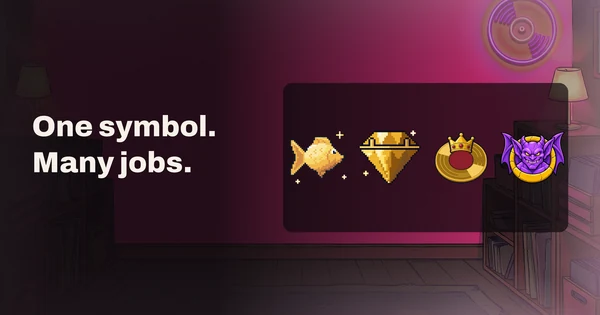
Kaiju Snack's Golden Fish is the plain kind. It substitutes for every paying symbol, and one Golden Fish can join several clusters at once, so a single wild between two groups can complete both. Mogu makes more of them: before a spin is evaluated he may bite a 2×2 or 3×3 block of the board, turning it into Wilds.

A wild that pays on its own
In Amethyst Crown the wilds are made, not landed. As paying tumbles heat the kiln, Amethysts turn into green Prasiolites and then golden Citrines, and both are wild. A cluster that contains a Citrine pays ×2, once per cluster. Five or more connected Citrines also pay on their own as a Citrine cluster, the highest-paying symbol, while Prasiolites alone do not form a cluster. The kiln explains the heat.
A wild that never pays alone
Needle Drop's Gold Record and Stonewake's imp join any group next to them and never pay alone, so a group made only of them pays nothing. Each has a second job.
The Gold Record lands only with the spin, never as a new symbol after a tumble. When one lands with two or more colours in play and a record on the board, the needle drops and turns every record of one colour into another colour still in play, before the wins are read.
The imp wakes its neighbours. When it lands, or drops in as a new symbol, every gargoyle kind next to it climbs one rank before the board's groups are read. An imp that only falls with a tumble does not wake them again.
A wild that does not count toward the size
Some wilds join a group without making it bigger. In Mimic Munch the mimic is a treasure chest on the board, a block of 2×2 cells or 3×3 once it has grown, and its cells are wild. Equal symbols on its two sides can form one cluster through it, but its cells never count toward the cluster's size: the cluster still needs 5 symbols of its own.
Domino Slam's fallen dominoes work the same way and carry a value. A fallen tile is a 2-cell wild worth the sum of its pips, 2 to 12 (more in its Grand Run feature). A winning group that runs through fallen tiles pays its win times the sum of their values, each tile counted once, and the tiles count neither toward its 5 symbols nor toward its size in the paytable. The dominoes show it step by step.
No wild at all
Neon Eclipse's rules say it plainly: there is no wild. The help sits in the cells instead: the first clear marks a cell, the second gives it a Moon Ward of ×2, and every clear after that doubles it, up to ×128.
Clockwork Peacock has no wild symbol either. Its gears sit on a plate behind the symbols, and a winning group that touches a train of them wins times the sum of its gears. Leaving the wild out moves the help from a symbol to the board.
Questions to ask about any wild
- Does it pay on its own, or only inside a group?
- Does it count toward the group's size, and so toward its row in the paytable?
- Can one wild join two groups at once?
- Can it arrive after a tumble, or only with the spin?
- Does it carry a value or a multiplier of its own?
The answers are in each game's rules, which every one of our game pages carries in full.