In Amethyst Crown a jeweller fires gemstones in a kiln, and two meters decide how a win is paid. The kiln heat changes the symbols. The crown collects the changed ones and turns them into a multiplier.
The board is 7 columns by 6 rows. Clusters of 5 or more identical symbols connected horizontally or vertically win together and are removed, the rest fall, new symbols drop in, and it repeats until nothing wins. Cluster pays and cascades covers that part.

The kiln heat
The heat runs from 0 to 4. Every tumble step that pays at least one cluster raises it by 1, after that step's removal. In the Base Game it starts at 0 on every spin.
- At heat 2 or 3, every Amethyst on the board becomes a green Prasiolite, wild.
- At heat 4, every Amethyst and Prasiolite becomes a golden Citrine, wild.
The change happens before a step is evaluated, and it includes symbols that just dropped in.
Wilds that pay double
Prasiolite and Citrine substitute for every paying symbol, but never for an Ember. A cluster that contains a Prasiolite is paid as usual, and a cluster made only of Prasiolites does not pay.
A cluster that contains at least one Citrine is paid ×2, once per cluster and not once per Citrine. Five or more connected Citrines also pay on their own as a Citrine cluster, and are doubled by the same rule.
The crown and its ten sockets
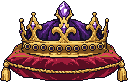
While the crown has a free socket, every Citrine that is part of a paying cluster is set into the next one; there are 10. The crown multiplier is 1 plus the sockets set (×22 after the Coronation), and it multiplies every cluster pay from the next step on, not the step that set the sockets. In the Base Game the crown empties at the start of every spin.
A worked example
This is a board chosen for the arithmetic, not a captured round. A spin has reached heat 4 and has 3 sockets set, so the crown is ×4.
- A cluster of 7 Rubies, one of them a Citrine, wins. Seven Rubies pay 320 hundredths of the base bet, 3.20×. With the Citrine's ×2 and the crown's ×4 the cluster pays 3.20 × 2 × 4 = 25.60×. The Citrine is set into the 4th socket, so the crown is now ×5.
- The next step, a cluster of 5 Pearls, two of them Citrines, wins. Five Pearls pay 40 hundredths, 0.40×. The ×2 is applied once, not twice: 0.40 × 2 × 5 = 4.00×. The two Citrines take sockets 5 and 6, and the crown is ×7.
The two steps pay 25.60 + 4.00 = 29.60× the base bet. Without Citrines and crown the same two clusters would pay 3.20 + 0.40 = 3.60×.
The Kiln and its Coronation
3, 4, 5 or 6+ Embers on the landed board award The Kiln, with 10, 12, 15 or 20 free spins. The base tumbles finish first. Embers never pay, are never substituted and are never removed.
In The Kiln the heat and the crown stay for the whole feature. Won from the base game, or bought for 100×, it starts at heat 0 with an empty crown. 3 or more Embers on a free spin add 5 free spins.
When the 10th socket is set, the Coronation happens: the feature gains 3 spins and the crown multiplier doubles once, to ×22. Citrines in a win when the crown is already full are removed without a socket.
Prices and the ceiling
Bellows costs 2× the base bet: every spin starts at heat 2, so Amethysts are Prasiolite wilds from the first evaluation, and Embers land more often. The Kiln can be bought for 100× the base bet: 10 free spins at heat 0 with an empty crown. Royal Firing costs 400×: 10 free spins at heat 4 with 3 sockets already set, a crown of ×4.
The max win is 10,000× the base bet per round, the base spin and The Kiln together, in every mode. Reaching it ends the round at once and remaining free spins are forfeited. What a max win cap means explains how a cap treats the win that crosses it.
Amethyst Crown's theoretical RTP is 96.50%, a long-run average that says nothing about a single session. How we test slot math describes how it is checked, cell and cascade multipliers compares the crown with other multiplier formulas, and the Amethyst Crown page has the symbols and the full rules.