Every one of our games has a sentence like this in its rules: "The max win is 50,000× the bet per round in every mode. Reaching it ends the round at once; remaining free spins are forfeited." That one is from Glasswright. It answers two questions: what the limit counts, and what happens when a round gets there.
A round, not a spin
The cap applies to a whole round: the spin you pay for and everything it leads to. That includes every tumble, the free spins a base spin triggers, the spins a retrigger adds and any payout at the end of a feature. Rust Rook's rules describe it as "the base spin and its feature together"; Mimic Munch's as "the spin, its free spins and the spit together", the spit being the hoard the chest pays out at the end.
Some games also say where the ceiling can be reached. In Shelf Life, the base game and the bet modes reach it only through the free spins they start. In Rust Rook, a base spin reaches it through the features, while Magnet Spin can also reach it in its one spin.
Counted in base bets, whatever the mode costs
The cap is a multiple of the base bet, the same reference the paytable uses. Crab Cargo's rules say so directly: all prices, paytable values and its 25,000× round limit refer to the base amount. A more expensive mode does not raise the ceiling.
That matters most for feature buys. Kaiju Snack's Mega Rampage costs 400× the base bet under a 10,000× cap, so the most it can return is 25 times its price. Glasswright's Dawn also costs 400×, under a 50,000× cap: at most 125 times its price. Both are ceilings, not likely results.
What happens at the ceiling
The win that crosses the cap pays only what is left below it. Then the round ends at once: no further tumble, spin or retrigger, and any free spins still to play are forfeited.
Here is the arithmetic with Glasswright's rules and a board chosen for the example. A group pays its paytable value times the sum of the panes under its cells (×1 when it has none). Suppose a free-spin round has paid 49,700× the base bet so far, and the next tumble has one winning group: five Owls, worth 1.50×, over panes of ×128, ×128, ×128, ×8 and ×8.
- The panes add up to 128 + 128 + 128 + 8 + 8 = 400.
- The group's win is 1.50 × 400 = 600×.
- Only 50,000 − 49,700 = 300× is left below the cap, so the tumble pays 300×.
- The round total is exactly 50,000×. The round ends, and the free spins left are not played.

Our games' ceilings
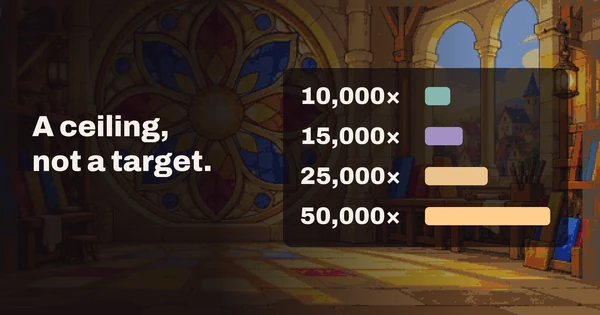
The caps in our live games' rules, per round and against the base bet, with each game's theoretical RTP:
- Kaiju Snack: 10,000×, RTP 96.50%
- Neon Eclipse: 10,000×, RTP 96.50%
- Amethyst Crown: 10,000×, RTP 96.50%
- Clockwork Peacock: 10,000×, RTP 96.70%
- Stompkin HD: 15,000×, RTP 96.50%
- Mimic Munch: 15,000×, RTP 96.70%
- Velvet Splice: 15,000×, RTP 96.70%
- Shelf Life: 15,000×, RTP 96.70%
- Rust Rook: 25,000×, RTP 96.70%
- Crab Cargo: 25,000×, RTP 96.50%
- Needle Drop: 25,000×, RTP 96.70%
- Stonewake: 25,000×, RTP 96.70%
- Triple Tray: 25,000×, RTP 96.70%
- Glasswright: 50,000×, RTP 96.70%
- Domino Slam: 50,000×, RTP 96.70%
- Grumbold's Toll: 100,000×, RTP 96.70%
What a higher ceiling changes
A cap is designed with the rest of a game's mathematics, and each game has its own way there: in Glasswright a group of 27 or more equal symbols reaches the 50,000× cap by itself, and the panes can take a feature there too; in Stompkin HD a group of 21 or more reaches its 15,000×.
A higher ceiling does not mean a higher return: all of our games sit between 96.50% and 96.70% RTP, Glasswright's 50,000× at the same 96.70% as the 15,000× games. Stake Engine's published math requirements ask that the maximum win be realistically obtainable, typically more often than once in 10,000,000 rounds, depending on the amount. At that threshold, rounds at the cap would hold 10,000 ÷ 10,000,000 = 0.001 of each 1× bet in a 10,000× game, a tenth of a percentage point of RTP, and 0.005, half a point, in a 50,000× game. Real games reach their caps at their own rates, so a higher cap does not always hold more of the return. Return held in the rarest rounds is not paid in ordinary ones, and that is one way a cap shapes a game's volatility.
A ceiling, not a target
The cap is the most a single round can pay, not what a round is likely to pay, and a higher cap does not make a game more generous. Our catalog lists the Engine games with the biggest max win, each beside its RTP and its volatility. Check the max win in the game's own rules for the mode you choose. Our RTP and volatility guide explains the long-run figures, and the guide to bonus buys compares a mode's price with what it buys.