In Glasswright the multiplier is not a counter beside the board. It is glass sitting in the cells. Every cell of the 7×7 board can hold a pane, a winning group is paid times the panes under it, and the panes grow each time a cell wins.
The wins themselves are a cluster tumble: groups of 5 or more equal symbols touching up, down, left or right pay together and are removed, the rest fall, new symbols drop in, and it repeats until no group pays. Cluster pays and cascades covers that part.

The pane ladder
Every cell holds a pane value. The ladder has nine rungs: clear, marked, then ×2, ×4, ×8, ×16, ×32, ×64 and ×128. "Marked" is a lead outline, the first sign of glass, and it is worth nothing yet.
Whenever a cell is part of a winning group and is removed, its pane moves up one rung (two in Rose Window): clear becomes marked, marked becomes ×2, ×2 becomes ×4, and so on. A ×128 pane stays at ×128.
Panes belong to the cells, not to the symbols. When symbols fall, the glass stays where it is. A new group that forms over a patch of glass is paid with that glass.
How a group is paid
A winning group pays its paytable value times the sum of the panes under its cells. Only panes of ×2 or more count, and a group with none is paid ×1. Panes are read before the step's removal, and only then do the removed cells climb a rung.
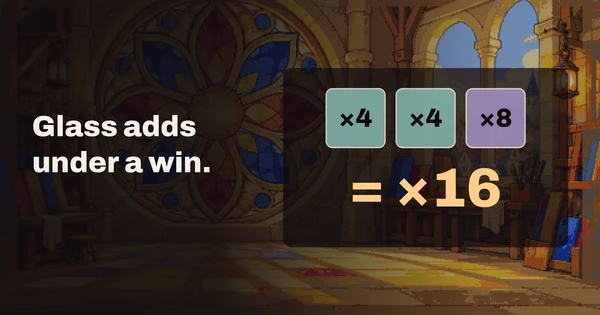
Because the panes add, a group sitting on ×4, ×4 and ×8 is paid ×16, not ×128.
When the panes clear depends on the mode. In the Base Game and Clear Sky every spin starts clear and the panes clear again when the spin ends. In free spins they stay for the whole feature.
Pip's Mirror, the sun beam and overflow
Three extras put glass on the board.
- Pip's Mirror. After the symbols land and before the first evaluation, a sunbeam crosses one whole row or column, and every cell on it climbs a rung; a clear or marked cell becomes ×2 at once. In the Base Game, Clear Sky and Glass Spin it comes now and then, only on a spin whose symbols land on a win (about 1 base spin in 7.5). In a feature it appears exactly once, on a free spin drawn from spins 3 to 8.
- The sun beam. In free spins, every Sun that lands fires one beam from its neighbouring cell straight to the edge of the board, and each cell it crosses climbs a rung, a clear or marked cell straight to ×2. Base spins never fire beams.
- Overflow. If a removed cell already held ×64 or more, its light spills: after the step, each orthogonal neighbour of such a cell climbs one rung too (once, even beside two such cells), a clear or marked neighbour straight to ×2.
A worked example
This is a board chosen for the arithmetic, not a captured round, in any mode but Rose Window. Take a group of five Owls, the highest paying symbol. Five Owls pay 150 hundredths of the base bet, 1.50×. Under its five cells lie, in turn, ×2, ×4, ×4, a marked cell and a clear cell.
- Panes of ×2 or more: 2 + 4 + 4 = 10. The marked and the clear cell add nothing. The group pays 1.50 × 10 = 15.00×.
- The five cells are removed and climb: ×2 becomes ×4, each ×4 becomes ×8, marked becomes ×2, clear becomes marked.
- Symbols fall, and suppose five Leaves land on exactly those five cells. Five Leaves pay 23 hundredths, 0.23×. The panes now read 4 + 8 + 8 + 2 = 22. The group pays 0.23 × 22 = 5.06×.
If nothing else wins, the two steps pay 15.00 + 5.06 = 20.06× the base bet. At ×1 the same two groups would pay 1.50 + 0.23 = 1.73×.
Features and the ceiling
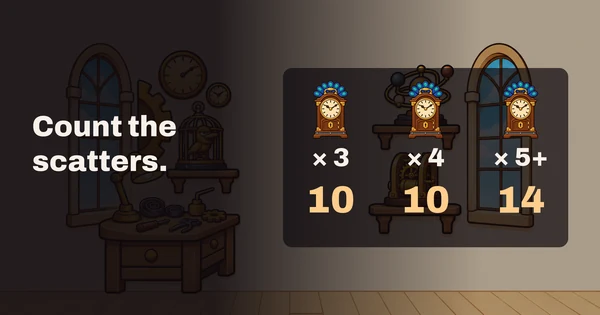
When a base spin's tumbles end, 3 Suns on the board start Glassworks (10 free spins), 4 start Dawn (10 free spins, with 6, 8 or 10 panes of ×4, ×8, ×16 or ×32 already set) and 5 or more start Rose Window (12 free spins: the central 3×3 starts at ×8, and every winning cell climbs two rungs per win). In a feature, 3 or more Suns when a free spin ends add 5 spins.
Glassworks can be bought for 100× the base bet and Dawn for 400×. Glass Spin costs 50× the base bet and plays one spin that starts with 10, 12 or 14 panes already set; its Suns can start a feature as in the base game.
The max win is 50,000× the base bet per round, in every mode, for the base spin and free spins together. Each step pays the lesser of its win and what is left under the cap, and reaching the cap ends the round at once. The max win cap explains what that means.
Glasswright's theoretical RTP is 96.70%, a long-run average that says nothing about a single session. How we test slot math explains how the figure is checked, cell and cascade multipliers compares panes with other multiplier formulas, and the Glasswright page has the symbols and the full rules.