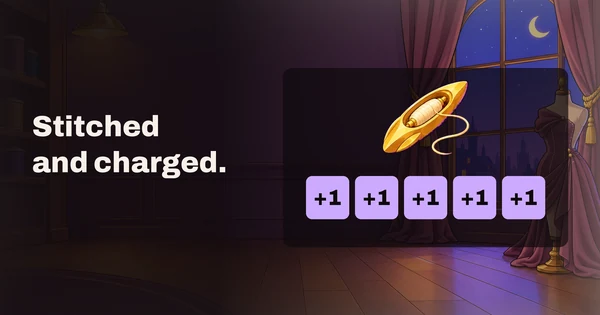
In Velvet Splice a moth couturier works late in a velvet atelier, and the piece to watch is a golden shuttle. It stitches a thread across touching cells, every stitch leaves a charge on its cell, and a winning group is paid more for every charge under it.
The board is 5×5 and the wins are a cluster tumble: groups of 5 or more equal paying symbols touching up, down, left or right win and vanish, the others fall, new symbols drop in, and it repeats until no group wins. Cluster pays and cascades covers that part.
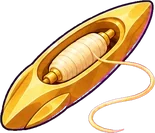
The shuttle stitches a thread
When a golden shuttle lands, it sets out from its cell and stitches a thread of touching cells. In the base game the thread sets out for 4 or 5 cells; in free spins a thread can run up to 16.
The shuttle stops early where it has no free neighbour. It never stitches a Moth Medallion, a cell already on its own thread or a golden shuttle still waiting to stitch. When several shuttles land, they stitch one after another, in reading order.
Every cell on the thread turns into the same symbol, so a thread of 5 or more cells is a ready-made winning group, unless a later shuttle's thread re-stitches some of its cells; a shorter thread wins only with equal symbols beside it. Each cell on the thread also gains +1 thread charge, up to 50 on a cell.
How a charge pays
A winning group wins its paytable value times 1 plus the thread charges on its cells. Charges add up across the group, and a group with none is paid ×1.
Charges belong to the cells, so they stay while symbols tumble. In the base game they clear when the spin ends. In free spins they stay until the feature ends, so the charges a thread leaves on the first free spin are still there on the last.
A worked example
This is a board chosen for the arithmetic, not a captured round. It plays in Night Weave free spins, where charges stay. Five Pincushions pay 50 hundredths of the base bet, 0.50×, and five Shears pay 60 hundredths, 0.60×.
- First spin: a shuttle stitches a thread of 5 cells that turns into Pincushions. Each cell gains 1 charge, 5 in total. The group wins 0.50 × (1 + 5) = 0.50 × 6 = 3.00×.
- Second spin: a new thread of 5 cells turns into Shears and crosses 2 of the cells charged before. Those two now hold 2 charges each, and the three new cells 1 each: 2 + 2 + 1 + 1 + 1 = 7. The group wins 0.60 × (1 + 7) = 0.60 × 8 = 4.80×.
If nothing else wins, the two spins pay 3.00 + 4.80 = 7.80× the base bet. With no charges the same two groups would pay 0.50 + 0.60 = 1.10×.

Free spins and the Long Thread
Three or more Moth Medallions on a spin start free spins, and the count decides the feature:
- 3 Medallions: Night Weave, 8 free spins with a golden shuttle every spin.
- 4: Velvet Run, 12 free spins that start with 4, 6, 8 or 10 charged cells, each charged 1, 2, 3, 5 or 8, and 1 or 2 shuttles every spin.
- 5 or more: Midnight Pattern, 16 free spins that start with 8, 10, 12 or 14 charged cells, each charged 2, 3, 5, 8 or 12, and 1 to 3 shuttles every spin. It cannot be bought.
3 or more Medallions on a free spin add 4 free spins. Medallions only land on a spin; they never drop in.
A thread of 9 or more cells is a Long Thread. Shuttle Spin costs 50× the base bet and plays one spin, whose Medallions can still start free spins, with a shuttle that sets out to stitch 9 to 12 cells; it stops early where no free neighbour is left, and about 1 Shuttle Spin in 7 ends with a thread of fewer than 9 cells.
Prices and the ceiling
Golden Thread costs 3× the base bet: shuttles land about twice as often, once every 3.5 spins instead of once every 7.5, and free spins trigger about 4 times as often. Night Weave can be bought for 100× the base bet and Velvet Run for 400×. Blind Pattern costs 160× and plays Night Weave in 80% of cases and Velvet Run in 20%. A bought feature starts with a spin that lands its Medallions, has no shuttle and no win, and pays nothing.
The max win is 15,000× the base bet per round, and reaching it ends the round at once. What a max win cap means explains how a cap treats the win that crosses it.
Velvet Splice's theoretical RTP is 96.70%, a long-run average that says nothing about a single session. How we test slot math describes how it is checked, cell and cascade multipliers compares charges with other multiplier formulas, and the Velvet Splice page has the symbols and the full rules.