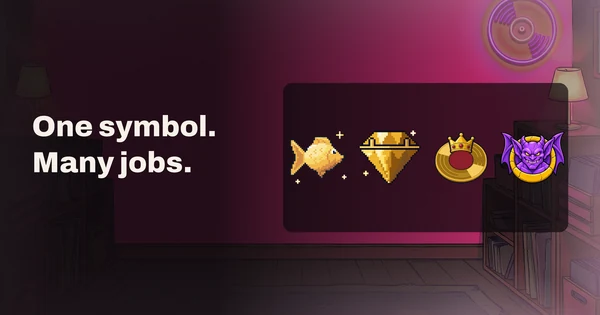
Stonewake, now live on Stake, puts six kinds of stone gargoyle on a gothic roof at night. There is no multiplier symbol and no cell multiplier. Instead each kind of gargoyle has its own rank: winning raises it, and so does a new imp landing beside it.
Groups and tumbles
The board is 6 columns by 5 rows. Groups of 5 or more equal symbols touching up, down, left or right win. Winning symbols leave, the rest fall, new ones drop in, and the board is checked again until no group wins. Cluster pays and cascades covers that part.
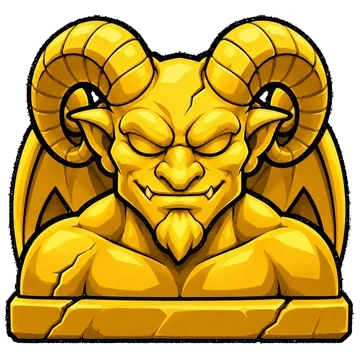
The six kinds are the Golden Ram, the Horned Demon, and the Bat, Lion, Owl and Toad Gargoyles. Paytable values are multiples of the base bet.
One ladder, one rank per kind
Every kind has a rank on the same ladder: ×1, ×2, ×3, ×5, ×8, ×12, ×20, ×30, ×50, ×100. A winning group pays its paytable value times its own kind's rank. Ranks of different kinds never multiply together.
After a tumble's wins are added, each kind that won climbs one rank, up to ×100. A kind at ×100 stays there. The climb is per kind, not per group: two Golden Ram groups that win in the same tumble lift the Golden Ram one rank, and both were paid at the old rank. A kind that did not win keeps its rank.
In the base game every kind starts each spin at ×1, so ranks do not carry into the next spin.
The imp wakes its neighbours
The imp is wild. It joins any group it touches and never pays on its own. When an imp lands, or drops in as a new symbol, each gargoyle kind next to it climbs one rank before that board's groups are read. An imp that only falls with the symbols in a tumble does not wake anyone again.
A worked example
Take the first two spins of a Moonrise feature, on boards chosen for the arithmetic, not a captured round. All six ranks start at ×1 and are kept from spin to spin.
- First spin, first tumble: five Golden Rams (2.85×) and five Owl Gargoyles (0.55×) win, both at ×1. 2.85 + 0.55 = 3.40×. The Ram and the Owl each climb to ×2.
- Same spin, second tumble: six Golden Rams (2.85×) at ×2 and five Toad Gargoyles (0.50×) at ×1. 2.85 × 2 + 0.50 = 6.20×. The Ram climbs to ×3 and the Toad to ×2.
- Second spin, first tumble: seven Golden Rams (5.70×) at ×3. 5.70 × 3 = 17.10×.
The three tumbles pay 3.40 + 6.20 + 17.10 = 26.70× the base bet. Played as two base spins, the same boards would pay 3.40 + 6.20 + 5.70 = 15.30×, because the second spin would start the Ram at ×1 again. The 11.40× difference is the rank the feature kept. These are the paytable's values: a group of 5 or 6 Golden Rams pays 2.85×, of 7 or 8 pays 5.70×; 5 Owl Gargoyles pay 0.55×; 5 Toad Gargoyles pay 0.50×.
Moons and the free spins
Moons never win. They are counted when a spin's tumbles end, so a moon that drops in during the tumbles counts too. After a base spin:
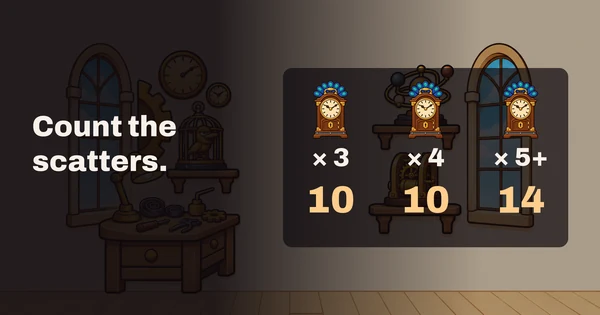
- 3 moons start Moonrise Spins: 10 free spins, every kind from ×1.
- 4 moons start Full Moon Spins: 10 free spins, every kind from ×5.
- 5 or more moons start Witching Hour: 12 free spins, every kind from ×5.
In the free spins the ranks stay from spin to spin until the last one. 3 or more moons when a free spin's tumbles end add 5 spins, under the same ranks. When the feature ends, every kind is at ×1 again.
One more feature is sold only from the menu: Wake Spin costs 50× the base bet, 4 free spins with every kind starting at ×8. The moon features can be bought too: Moonrise Spins cost 100×, Full Moon Spins 400×, and Mystery Moon 500×, which opens Full Moon Spins (80%) or Witching Hour (20%). The Ante, at 3× the base bet, makes moons land more often: a feature starts about 1 spin in 58, against 1 in 283 in the base game. A higher starting rank is a starting point, not a result.
The ceiling and the long run
Stonewake caps a round at 25,000× the base bet in every mode, and reaching it ends the round at once. Stonewake's theoretical RTP is 96.70%. It is a long-run average and the cap is a ceiling; neither predicts a session. Our guide to the max win cap explains how a cap works, how we test slot math explains RTP, and cell and cascade multipliers sets ranks beside other multiplier rules. The Stonewake game page has the symbols and the full rules.